NCERT Solution of Class 6 Maths Chapter 3, In this chapter of class 6 we provide the solution of folllowing exercise.
The student can learn online and they can download the solution in pdf format
- Solution Exercise 3.1
- Solution Exercise 3.2
- Solution Exercise 3.3
- Solution Exercise 3.4
- Solution Exercise 3.5
- Solution Exercise 3.6
- Solution Exercise 3.7
- Download the solution in PDF of Exercise 3.1, Exercise 3.2, Exercise 3.3, Exercise 3.4, Exercise 3.5, Exercise 3.6 and Exercise 3.7

Solution Exercise 3.6
Solution of class 6 maths ncert chapter 3 Solution Exercise 3.7
Question 1:
Find the HCF of the following numbers :
(a) 18, 48 (b) 30, 42 (c) 18, 60
(d) 27, 63 (e) 36, 84 (f) 34, 102
(g) 70, 105, 175 (h) 91, 112, 49 (i) 18, 54, 81
(j) 12, 45, 75
Answer 1:
(a) 18 = 2×3×3 and 48 =2×2×2×2×3
Common factors of 18 and 48 are 2 and 3
Hence HCF of 18 and 48 is 2×3=6
(b) 30 =2×3×5 and 42 =2×3×7
Common factors of 30 and 42 are 3 and 5
Hence HCF of 30 and 42 is 2×3=6
(c) 18 =2×3×3 and 60 =2×2×3×5
Common factors of 18 and 60 are 2 and 3
Hence HCF of 18 and 60 is 2×3=6
(d) 27 =3×3×3 and 63 =3×3×7
Common factors of 27 and 63 are 3 and 3
Hence HCF of 27 and 63 is 3×3=9
(e) 36 =2×2×3×3 and 84 =2×2×3×7
Common factors of 36 and 84 are 2, 2 and 3
Hence HCF of 18 and 60 is 2×2×3=12
(f) 34 =2×17 and 102 =2×3×17
Common factors of 34 and 102 are 2 and 17
Hence HCF of 18 and 60 is 2×17=34
(g) 70 =2×5×7 , 105 =3×5×7 and 175 =5×5×7
Common factors of 70 , 105 and 175 are 5 and 7
Hence HCF of 18 and 60 is 5×7=35
(h) 91 =7×13 , 112 =2×2×2×2×7 and 49 =7×7
Common factors of 91 , 112 and 49 are 7
Hence HCF of 91 , 112 and 49 is 7
(i) ) 18 =2×3×3 , 54 =2×3×3×3 and 81 =3×3×3×3
Common factors of 18, 54 and 81 are 3 and 3
Hence HCF of 18, 54 and 81 is 3×3=9
(j) 12 =2×2×3 , 45 =3×3×5 and 75 =3×5×5
Common factors of 12, 45 and 75 are 3
Hence HCF of 12, 45 and 75 is 3
Question 2:
What is the HCF of two consecutive
(a) numbers? (b) even numbers? (c) odd numbers?
Answer 2:
(a) Let two consecutive numbers are 1 and 2
There are no any factors which is common except 1, Therefore HCF is 1
(b) Let two consecutive even numbers are 2 and 4
There are 2 is a common factors , Therefore HCF is 2
(c) Let two consecutive even numbers are 3 and 5
There are no any factors which is common except 1, Therefore HCF is 1
Question 3:
HCF of co-prime numbers 4 and 15 was found as follows by factorisation :
4 = 2 × 2 and 15 = 3 × 5 since there is no common prime factor, so HCF of 4 and 15 is 0. Is the answer correct? If not, what is the correct HCF?
Answer 3:
No! Here common factor is 1 not zero. Therefore HCF is 1
Solution Exercise 3.7
Direct access ncert solution of class 6 maths chapter 3 Exercise 3.6
Question 1:
Renu purchases two bags of fertiliser of weights 75 kg and 69 kg. Find the maximum value of weight which can measure the weight of the fertiliser exact number of times.
Answer 1:
Weight of fertiliser bags are 75 kg and 69 kg
Maximum value of weight which measure the weight of the fertiliser exact umber of times, means we have find HCF of 75 and 69
Now, 75 = 3×5×5 and 69 = 3×23
Here common factor of 75 and 69 is 3. Therefore HCF is 3.
Hence 3kg is a maximum weight which can measure exact number of times.
Question 2:
Three boys step off together from the same spot. Their steps measure 63 cm, 70 cm and 77 cm respectively.
What is the minimum distance each should cover so that all can cover the distance in complete steps?
Answer 2:
Measure of steps of boys are 63 cm, 70 cm and 77 cm. For minimum distance, so that each can cover in complete steps, means we have find LCM of 63, 70 and 77

LCM of 63, 70 and 77 = 2×3×3×5×7×11= 6930
Hence boys cover 6930 cm distance for complete steps.
Question 3:
The length, breadth and height of a room are 825 cm, 675 cm and 450 cm respectively.
Find the longest tape which can measure the three dimensions of the room exactly.
Answer 3:
We have to find HCF of 825, 675 and 450
Prime factorisation of
825 = 3×5×5×11
675 = 3×3×3×5×5
450 = 2×3×3×5×5
Now common factors are 3, 5 and 5
Therefore HCF = 3×5×5=75
Hence, the length of tape will be 75cm, that can measure the dimention of the wall exactly.
Question 4:
Determine the smallest 3-digit number which is exactly divisible by 6, 8 and 12.
Answer 4:
We have find the LCM of 6, 8 and 12
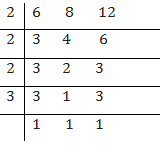
Thus LCM = 2×2×2×3=24
It is known that smallest 3-digit number is 100.
So, any multiple of 24 , which near to 100 will be required answer.
24×1=24
24×2=48
24×3=72
24×4=96
24×5=120
Here 120 is near to 100. Therefore it is required answer.
Hence smallest 3-digit number which is exactly divisible by 6, 8 and 12 is 120.
Question 5:
Determine the greatest 3-digit number exactly divisible by 8, 10 and 12.
Answer 5:
Here we have find the LCM of 8, 10 and 12
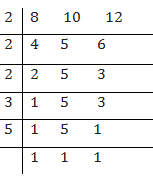
Now LCM 8, 10 and 12 is
= 2×2×2×3×5=120
It is known that greatest 3-digit number is 999. Therefore the multiple of 240 which is near to 999 will be required result.
120×1=120
120×2=240
.
.
.
120×8=960
960, which is near to 999
Hence greatest 3-digit number which is exactly divisible by 8, 10 and 12 is 960.
Question 6:
The traffic lights at three different road crossings change after every 48 seconds, 72 seconds and 108 seconds respectively. If they change simultaneously at 7 a.m., at what time will they change simultaneously again?
Answer 6:
We have find the LCM of 48, 72 and 108.

Now LCM of 48, 72 and 108
= 2×2×2×2×3×3×3=432
The traffic light change simultaneously after 432 second past 7 a.m.
Hence traffic light change 7minute 12 seconds past 7 a.m.
Question 7:
Three tankers contain 403 litres, 434 litres and 465 litres of diesel respectively. Find the maximum capacity of a container that can measure the diesel of the three containers exact number of times.
Answer 7:
Here we have find the HCF of 403, 434 and 465
Prime factorisation of
403 = 13×31
434 = 2×7×31
465 = 3×5×31
The common factor of 403, 434 and 465 is 31. Therefore HCF is 31
Hence maximum capacity of container that can measure the diesel exactly, is 31 litre.
Question 8:
Find the least number which when divided by 6, 15 and 18 leave remainder 5 in each case.
Answer 8:
least number which when divisible by 6, 15 and 18, will be LCM of 6, 15 and 18.
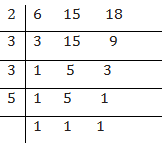
Now LCM of 6, 15 and 18
= 2×3×3×5=90
Therefore LCM is 90
Now according to question these number leave remainder 5, required number is
90 + 5 = 95
Hence 95 is least number when it is divided by 6, 15 and 18. It leave 5 as remainder.
Question 9:
Find the smallest 4-digit number which is divisible by 18, 24 and 32.
Answer 9:
We have find LCM of 18, 24 and 32
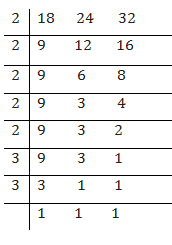
LCM of 18, 24 and 32
= 2×2×2×2×2×3×3=288
It is knwn that smallest 4-digit number is 1000, Any multiple of 288 which is near to 1000 will be required answer.
So, 288×1=288
288×2=576
288×3=884
288×4=1152
Hence smallest 4-digit number which is divisible by 18, 24 and 32 is 1152.
Question 10:
Find the LCM of the following numbers :
(a) 9 and 4 (b) 12 and 5 (c) 6 and 5 (d) 15 and 4
Observe a common property in the obtained LCMs. Is LCM the product of two
numbers in each case?
Answer 10:
(a) Prime factorisation of
9 = 3×3 and 4 = 2×2
Hence LCM of 9 and 4 = 3×3×2×2=36
(b) Prime factorisation of
12 = 2×2×3 and 5 = 5
Hence LCM of 12 and 5 = 2×2×3×5=60
(c) Prime factorisation of
6 = 2×3 and 5 = 5
Hence LCM of 12 and 5 = 2×3×5=30
(d) Prime factorisation of
15 = 3×5 and 4 = 4
Hence LCM of 15 and 4 = 3×5×4=60
Here in each case LCM is multiple of 3.
Question 11:
Find the LCM of the following numbers in which one number is the factor of the other. (a) 5, 20 (b) 6, 18 (c) 12, 48 (d) 9, 45
What do you observe in the results obtained?
Answer 11:
(a) 5, 20
Prime factorisation of
20 = 2×2×5 and 5 = 5
Hence LCM of 20 and 5 = 2×2×5=20
(b) 6, 18
Prime factorisation of
6 = 2×3 and 18 =2×3×3
Hence LCM of 6 and 18 = 2×3×3=18
(c) 12, 48
Prime factorisation of
12 = 2×2 ×3 and 48 =2×2×2×2×3
Hence LCM of 12 and 48 = 2×2×2×2×3=48
(d) 9, 45
Prime factorisation of
9 = 3×3 and 45 =3×3×5
Hence LCM of 9 and 45 = 3×3×5=45