Get solution of all the questions of RS Aggarwal Class 10 Chapter 10 Exercise 10B Solution (Profit and Loss)
RS Aggarwal Class 8 Profit and Loss Ex. 10B Solution
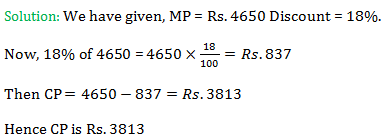
1: The marked price of a water cooler is Rs. 4650. The shop keeper offers an off- season discount of 18% on it. Find its selling price.
2: The price of a sweater was slashed from Rs. 960 to Rs. 816 by a shopkeeper in the winter season. Find the rate of discount given by him.

3: Find the rate of discount being given on a shirt whose selling price is Rs. 1092 after deducting a discount of Rs. 208 on its marked price.

4: After allowing a discount of 8% on a day. It is sold for Rs. 216.20. Find the marked price of the toy.

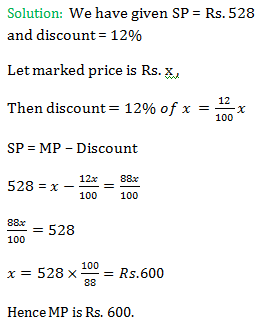
5: A tea set was bought for Rs. 528 after getting a discount of 12% on its marked price. Find the marked price of the tea set.
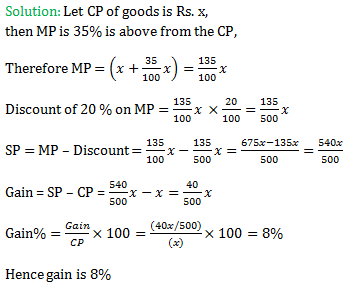
6: A dealer marks his goods at 35% above the cost price and allows a discount of 20% on the marked price. Find his gain or loss per cent.
7: A cellphone was marked at 40% above the cost price and a discount of 30% was given on its marked price. Find the gain or loss per cent made by the shopkeeper.

8: A dealer purchased a fan for Rs. 1080. After allowing a discount of 25% on its marked price. He gains 25%. Find the marked price of the fan.

9: A dealer bought a refrigerator for Rs. 11515. After allowing a discount of 16% on its marked price, he gains 20%. Find the marked price of the refrigerator.

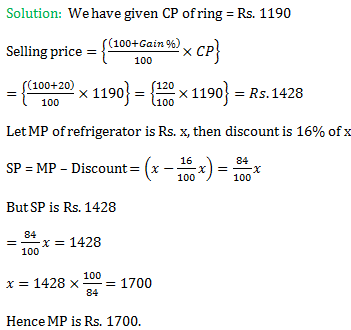
10: A jeweller allows a discount of 16% to his customers and still gains 20%. Find the marked price of a ring which costs the jeweller Rs. 1190.
11: After allowing a discount of 10% on the marked price, a trader still makes a gain of 17%. By what per cent is the marked price above the cost price?

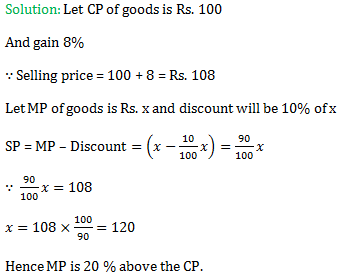
12: How much per cent above the cost price should a shopkeeper marks his goods so that after allowing a discount of 10% on the marked price, he gains 8%?
13: The marked price of a TV is Rs. 18500. A dealer allows two successive discount of 20% and 5%. For how much is the TV available?

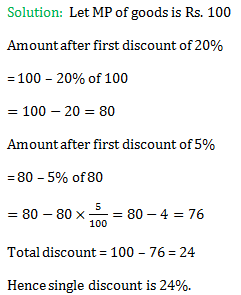
14: Find the single discount which is equivalent to two successive discounts of 20% and 5%.