Get solutions of all questions of rs aggarwal class 8 chapter 4 exercise 4a solution, (Cubes and Cube Roots).
RS Aggarwal Class 8 Maths Ex. 4a Solution
1: Evaluate:

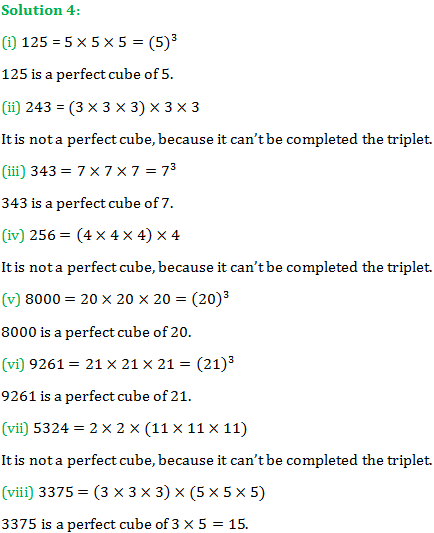
4: Which of the following numbers are perfect cubes? In case of perfect cube. Find the number of whose cube is the given number.
(i) 125 (ii) 243 (iii) 343 (iv) 256
(v) 8000 (vi) 9261 (vii) 5324 (viii) 3375
5: Which of the following the cube of even numbers:
(i) 216 (ii) 729 (iii) 512 (iv) 3375 (v) 1000
Solution 5:
Since, it is known that the cube of every even number is even.
So, 216, 512 and and 1000 are even number so it is a cube of odd number.
6: Which of the following the cube of odd numbers:
(i) 125 (ii) 343 (iii) 1728 (iv) 4096 (v) 9261
Solution 6:
Since, it is known that the cube of every odd number is odd.
So, 125, 343 and and 9261 are odd number so it is a cube of odd number.
7: Find the smallest number by which 1323 must be multiplied so that product is a perfect cube.
Solution 7:
Writing 1323 as a product of prime factors, we have
1323=(3×3×3)×7×7
Clearly to make perfect cube, it must be multiplied by 7.
8: Find the smallest number by which 2560 must be multiplied so that the product is a perfect cube.
Solution 8:
Writing 2560 as a product of prime factors, we have
2560=(2×2×2)×(2×2×2)×(2×2×2)×5
Clearly to make perfect cube, it must be multiplied by 5×5 i.e. 25.
9: What is the smallest number by which 1600 must be divided so that the quotient is a perfect cube.
Solution 9:
Writing 1600 as a product of prime factors, we have
1600=(2×2×2)×(2×2×2)×5×5
Clearly to make perfect cube, it must be divided by 5×5 i.e 25.
10: Find the smallest number by which 8788 must be divided so that the quotient is a perfect cube.
Solution 10:
Writing 8788 as a product of prime factors, we have
1600=2×2×(13×13×13)
Clearly to make perfect cube, it must be divided by 2×2 i.e. 4.